
Villagers alleged that the move to enclose the settlement without completing rehabilitation measures was coercive and would restrict access to the village. Many of the affected families, belonging to Backward Classes (BC) and Scheduled Castes (SC), had earlier parted with their land for the project.
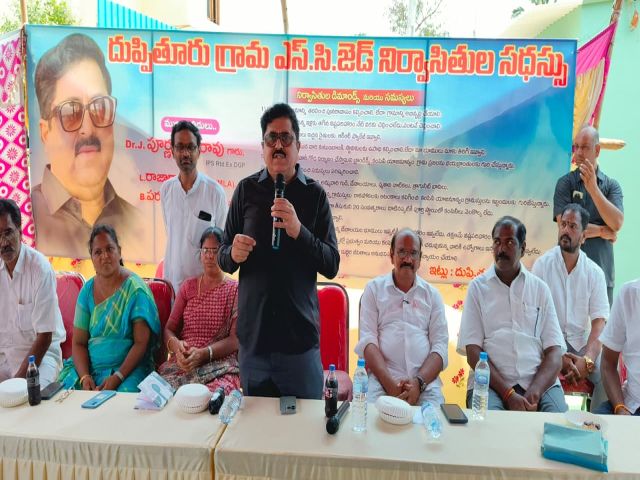
At a meeting held in the village, attended by elders, community leaders and residents, concerns were raised over what was described as incomplete rehabilitation and lack of basic amenities. Local leader Madem Suri Appa Rao said that constructing a wall without ensuring proper resettlement and facilities was unjust. Village sarpanch Devishetty Shankar Rao and PACS representative D.V. Ramana were present.
Residents cited lack of adequate rehabilitation, absence of assured livelihood support and proposed closure of access routes as key issues. They termed the ongoing developments as “pressure rather than development”.
⸻
Concerns over livelihood and compensation
Addressing the gathering, Dr. J. Purnachandra Rao, IPS (Retd.), National Coordinator, questioned the long-term impact of land acquisition on affected families.
He said that one-time monetary compensation was insufficient to secure the future of displaced households, noting that while industries generated sustained profits, land-losers often faced economic distress within a few years.
“Land is permanently lost, while compensation is temporary. However, industrial profits continue over decades. There is a need to examine whether affected families should have a share in such benefits,” he observed.
⸻
Legal and constitutional aspects
Dr. Rao referred to judicial pronouncements linking land rights to the right to livelihood under Article 21 of the Constitution. He stated that displacement without adequate rehabilitation and sustainable livelihood measures could raise concerns regarding the protection of fundamental rights.
⸻
Changing socio-economic conditions
Speakers pointed out that in villages such as Duppitur, many former landholders had taken up wage labour, while younger members of families were migrating in search of employment. Women, they said, were increasingly engaged in insecure and informal work.
⸻
Demands placed before authorities
Among the demands raised at the meeting were:
* A share in industrial profits for affected families
* Provision of annual annuity for a period of 25–30 years
* Equity participation in companies for land-losers
* Clarification on employment commitments, with allegations that fewer jobs had been provided than initially promised
* Return of reportedly unused land to original owners
Dr. Rao said that affected families should be treated as stakeholders in development rather than as beneficiaries of one-time compensation.
⸻
Reference to other models
He cited examples such as land pooling in Amaravati, revenue-sharing mechanisms in Canada and sovereign fund models in Norway to argue for long-term benefit-sharing approaches in land acquisition.
⸻
Call for dialogue
Former MLA L. Rajarao and advocate B. Varanjith, who also spoke at the meeting, urged the government to halt the wall construction and initiate discussions with villagers to resolve the issue.
⸻
Protests to continue
Villagers stated that their agitation would continue until their demands for fair rehabilitation, livelihood security and equitable benefits were addressed.