
At a report launch in New Delhi, senior government officials and civil society leaders call for skilling programmes to build confidence and aspiration alongside capability; and for systemic support before, during, and after placement
India has trained and certified over 1.40 crore candidates under its flagship Pradhan Mantri Kaushal Vikas Yojana in the past decade. It has built one of the largest skilling ecosystems in the world. And yet, a young woman from a tribal village in Rayagada, Odisha, can complete that training, migrate to a garment factory in Tamil Nadu's Tiruppur, sign a formal contract and still not know she is entitled to use her ESIC card — a social security ID that provides medical care and income support — when she falls ill. Her supervisor holds it.
This finding comes from What Does It Take? Rural Women, Migration, and the Road to Work, a new report by JustJobs Network and PRADAN. The report was launched on April 30th in New Delhi before an audience of policymakers, researchers, civil society organisations, and industry representatives.
The report examines not only why rural women are not working, but also how to enable them to remain in work.
Setting the scene
In his opening address, Charanjit Singh, Former Additional Secretary, Ministry of Rural Development, framed the challenge in striking data. Female labour force participation in India stands at 40 percent, well below countries such as Vietnam (68.6 percent) and Nigeria (80.7 percent). Compounding this, dropout rates across education levels remain high, roughly a quarter each at secondary and higher secondary stages, limiting women’s access to better employment.
Singh questioned why industrial skilling infrastructure schemes such as PM MITRA, designed to connect the full supply chain from farm to factory to foreign markets, have not taken root in states like Bihar or Chhattisgarh. Such schemes could give women access to work without migrating thousands of kilometres from home. “Skill and industry must go together,” he said. “We cannot treat them as separate tracks.”
The keynote was delivered by Debashree Mukherjee, Secretary, Ministry of Skill Development and Entrepreneurship, who acknowledged the report’s central provocation. “The real question is not just how women get jobs, but how they sustain them and grow within them,” she said, noting that skilling programmes must build confidence and aspiration alongside capability. She pointed to the paradox at the heart of India's skilling challenge: that women who hold formal contracts and provident fund entitlements on paper often do not know how to access what they are legally owed. She also called for studying whether internal migration is genuinely increasing women’s agency and financial autonomy over the long run, and for stronger support systems for entrepreneurship among women who remain within their communities.
The report’s findings
According to the latest Periodic Labour Force Survey 2025, 42.8 percent of young Indian women are not in education, employment, or training — nearly five times the rate for young men. Among those who do work in rural areas, 91 percent are in self-employment or casual labour. Only nine percent hold regular salaried positions.
The report, authored by Isha Gupta and Renjini Rajagopalan, Research Leads at JustJobs Network, is based on fieldwork across Rayagada, Odisha and employment hubs in Coimbatore, Tiruppur, Hosur, and Bengaluru. It identifies what actually determines whether a woman stays in formal work: confidence-building before training begins; family consent secured through transparency and structured exposure visits; peer support networks at the destination; and post-placement follow-up in the critical first six to twelve months, when most exits happen.
The findings carry specific structural weight. Among Scheduled Tribe rural young women — already among the most economically active — only 5.7 percent hold regular salaried roles, despite a labour force participation rate of 53.4 percent. High participation, the report argues, has consistently been mistaken for adequate outcomes.
The report concludes with actionable recommendations for central and state governments, training organisations, and employers, centred on one shared argument: sustainable employment for rural women requires coordinated institutional responsibility, not just training targets.
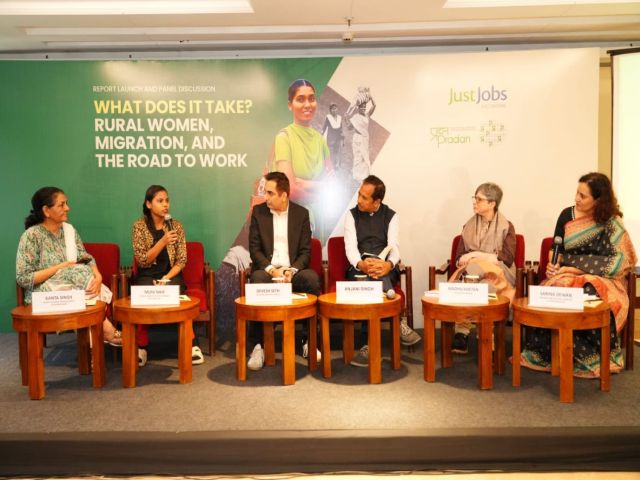
The panel
The discussion, moderated by Sabina Dewan, President and Executive Director, JustJobs Network, brought into focus a web of interconnected structural barriers. Kanta Singh, Deputy Country Representative at UN Women noted that women who migrate in groups fare significantly better than those who travel alone. She also observed that many of the constraints that women face, from wage gaps to safety risks, stem from how society raises daughters versus sons.
Devesh Seth, Associate Director at Adecco identified a persistent expectation-versus-reality gap: workers arrive at industrial hubs unprepared for the actual conditions of work and life, and leave. He called for incubation centres that expose prospective migrants to workplace realities before departure, alongside basic fixes to housing, commute, and food.
Anjani Singh, Senior Programme Officer at the Gates Foundation emphasised that the largest migration most women in India undergo is driven by marriage, not employment and that migration resource centres at destinations are urgently needed.
Muni Naik, a trainee from an apprenticeship programme, reflected on her own experience: family resistance, lack of information in rural areas, and the need for continuous institutional follow-up were not abstractions for her. They were the conditions of her working life.
The full report is available here: https://justjobsnetwork.org/research/reports/what-does-it-take-rural-women-migration-and-the-road-to-work/